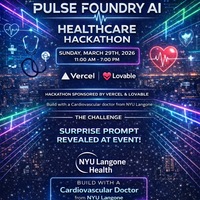
Pulse Foundry AI — Hackathon
Pulse Foundry AI Healthcare Hackathon
Reimagining Cardiac Rehabilitation
Prize Pool
Non-cash Prize
Location
Online
Duration
1 day
Date
Mar 28, 2026 - Mar 29, 2026
About the Hackathon
Reimagining Cardiac Rehabilitation
Healthcare Hackathon 2026 — Reimagining Cardiac RehabilitationThis hackathon is about building apatient-centered proof of conceptthat helps people like Maria completecardiac rehabilitationdespite distance, time, fear, and the gap between clinical evidence and real life.Cardiac rehab is one of the most evidence-backed paths after a heart event—yetonly about 1 in 4eligible patients attends even a single session. Your job is to prototype alifeline, not a generic fitness tracker or static education site.1. The Story: Maria’s GapMaria is 58. Three weeks ago, she had a stent placed after a sudden heart attack. Today, she is back home. The physical pain is gone, replaced by a quiet, heavy anxiety.The clinical path forward is clear:cardiac rehabilitation.If Maria completes this 12-week program of supervised exercise and support, her risk of death or rehospitalization drops by43%. If 70% of patients like Maria participated, we would save 25,000 lives this year.But the reality is different.Maria lives 40 minutes from the nearest clinic. She works part-time and can’t afford to miss the hours. She feels “fine” now, so she wonders if the effort is worth the commute. She’s afraid to push her body, but she doesn’t want to worry her daughter by asking for help.Maria is one of two million Americans trapped in theParticipation Paradox: the science is strong, but the human connection and logistics are broken. Currently,only 1 in 4eligible patients ever attends a single session. For every day that passes after discharge, Maria’s chance of enrolling drops by 1%.2. Meet Your PatientMaria, 58, had a stent placed three weeks ago after a mild heart attack. She’s been cleared to start outpatient cardiac rehab, but hasn’t gone yet. The nearest facility is a 40-minute drive, and she can’t miss more time from her part-time job. She lives alone, feels anxious about pushing her body too hard, and isn’t sure the program is worth the effort now that her chest pain is gone. Her daughter checks in by phone most evenings, but Maria doesn’t want to worry her.Maria is the person your solution is for.She’s not a dataset or a clinical profile. She’s someone trying to get back to normal life while quietly afraid it could happen again. Keep her in mind as you build.3. What Cardiac Rehab IsCardiac rehab is amedically supervisedrecovery program prescribed after a heart attack, heart surgery, stent placement, or heart failure diagnosis. The standard course is36 one-hour sessionsover about12 weeks, led by a team of cardiologists, nurses, exercise specialists, dietitians, and psychologists.3.1 Three PhasesPhase I (in hospital):Gentle mobilization, education, and discharge planning.Phase II (outpatient core):Supervised sessions about three times per week—monitored exercise, nutrition coaching, stress management, and risk factor education.Phase III (maintenance):Patients continue on their own. This is where most people drop off.4. More Than ExercisePeople often think of cardiac rehab as a gym program, but a typical session can include a supervised workout, a short class on nutrition labels, a conversation about stress at home, and a check-in on emotional well-being. Over time, teams help patients with blood pressure, cholesterol, smoking cessation, weight, and medication adherence.Takeaway:Your prototype should reflect this breadth—education, mood, adherence, and lifestyle belong in the same conversation as exercise.5. Why People Don’t ParticipateLow participation is usually aboutbarriers and context, not laziness. Design against friction such as:Distance to a facility and lack of transportationWork or caregiving conflicts and out-of-pocket costsDifficulty understanding medical instructions or language barriersDepression or anxiety after a cardiac eventWeak referral or recommendation from a doctorThe belief that rehab isn’t necessary once symptoms go away6. The Challenge: Bridge the GapYour mission is toreimagine the cardiac rehabilitation journey. In the time allotted, your team must design and prototype a solution that turns a clinical mandate into a journey a patientchoosesto complete.How do you bring the expertise of a care team into the living rooms of the rural, the busy, and the afraid?7. Your ObjectiveBuild a workingproof of conceptthat addresses the Participation Paradox. Move beyond simple tracking. Tackle thepsychological and logistical wallsthat stop patients like Maria from starting and staying in recovery.8. Metrics Worth KnowingYou don’t need to be a clinician to think about impact. Consider:Are patients showing up?The program has 36 sessions; timeliness after discharge matters.Are they getting stronger?Daily habits and prescribed routines support improvement over time.Are health numbers moving the right way?Blood pressure, cholesterol, weight, and smoking status are core targets.How do they feel?Depression, anxiety, confidence, and quality of life often determine whether people keep going.
Event Details
Format
Online
Prize Pool
Non-cash Prize
Currency
USD
Start
Mar 28, 2026
End
Mar 29, 2026
Duration
1 day
Organized by Pulse Foundry AI
Online · Ended
Timeline
Mar 28, 2026
EVENT STARTS
Hackathon kicks off. Join online and start building.
Mar 29, 2026
EVENT ENDS
Final submissions and judging period begins.